

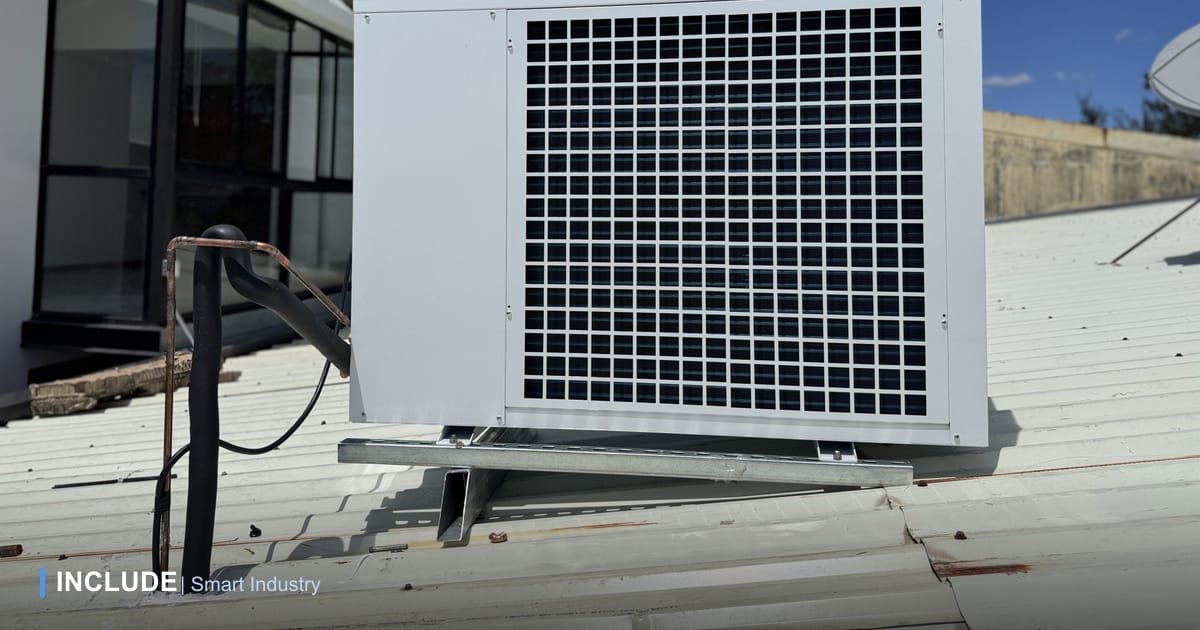
In a tropical climate like Indonesia's, cooling is almost always one of the largest electricity users in offices, shops, and commercial buildings. Ironically, air conditioning is also one of the loads least often measured on its own. Everyone knows the bill is high, but nobody knows the share that goes to AC, which floor wastes the most, or whether units keep running after the office closes.
This article covers steps to cut office air conditioning energy starting from data, so every change can be proven.
Measure the AC share first
The first step is not replacing units but measuring. Separate AC usage from other loads with an energy meter on the AC panel or on each floor's panel. After a few weeks you will see:
- What percentage of the bill comes from cooling.
- The daily pattern: when AC starts, when it peaks, and when it truly switches off.
- Differences between floors or zones with similar use.
Setpoints: a small change with real impact
Setting rooms too cold is the most common waste. Each one-degree increase in setpoint generally cuts cooling energy by a few percent, because the compressor no longer works as hard. Moving from 22 °C to 24 °C often makes little difference to comfort, as long as air circulation is good.
The key is consistency. Setpoints changed back and forth by occupants make savings hard to measure. Set a standard, then monitor usage before and after.
Operating schedules
- AC starts before the office opens. Pre-cooling is needed, but it often starts far earlier than necessary.
- AC keeps running after the office closes, in meeting rooms, empty floors, or rarely used areas.
- Weekends and holidays. Usage data while the building should be empty is often the most surprising finding.
All these patterns are obvious on an hourly usage chart. Without data, waste like this can go on for years.
Maintenance that affects electricity
- Dirty filters and evaporators reduce airflow, so units run longer to reach the same temperature.
- Dirty or blocked outdoor condensers make compressors run at higher pressure.
- Refrigerant leaks reduce cooling capacity, so units run longer.
Electricity use per unit or per zone that creeps up with no change in occupancy or weather is a sign that maintenance should be brought forward.
Proving the savings
Each step above should be measured. Compare usage over a few weeks before and after the change, on working days with similar patterns. Weather matters too: hotter days need more cooling, so compare comparable periods. Measured results make it easier for building managers to convince management to take the next step, such as replacing old units with inverter models.
Split units or a central system
The approach differs slightly by system type:
- Split and VRF systems are spread across many units. Waste usually comes from units left on and inconsistent setpoints. Measuring per panel or per floor is enough to find the patterns.
- Central systems with chillers are concentrated in a plant room. Chillers, pumps, and cooling towers are best measured separately, because each has its own saving opportunities, such as chilled water temperature and chiller sequencing.
An illustrative setpoint calculation
An example with assumptions: cooling accounts for 50,000 kWh a month in a building. If raising the average setpoint by two degrees cuts cooling energy by about 5%, the saving is about 2,500 kWh a month. At an assumed rate of Rp1,400 per kWh, that is about Rp3.5 million a month, with no equipment investment at all. The exact figure depends on the building and the weather, which is exactly why it needs measuring.
Bring occupants along
AC savings last longest when occupants understand the reason. Share per-floor usage charts regularly and explain the agreed setpoint standard. Floors whose usage drops can serve as an example for the others.
Frequently asked questions
What is the ideal office AC temperature?
Many buildings use 24 to 26 °C as a standard. What matters most is consistency and good air circulation.
Does switching AC off at lunch save energy?
For rooms that are truly empty, usually yes. For rooms that fill again soon, the benefit is smaller because the unit has to cool the room down again.
When should an AC unit be replaced?
When its electricity and repair costs keep rising, or it no longer has enough capacity. Per-unit usage data lets you decide with numbers.
Monitoring AC usage with InEnergy
InEnergy for energy and buildings shows usage per panel in real time, with hourly patterns and cost estimates. Put an IncludeBox Energy Meter on the AC panel or each floor's panel, then set an alarm when cooling load stays high outside operating hours. If the building has many other large loads, submetering helps separate them cleanly.
Is your building bill dominated by air conditioning?
Tell us how many floors you have and what AC system you use. The INCLUDE team will help pick measurement points for InEnergy.
Free consultation on WhatsApp → See InEnergy →