

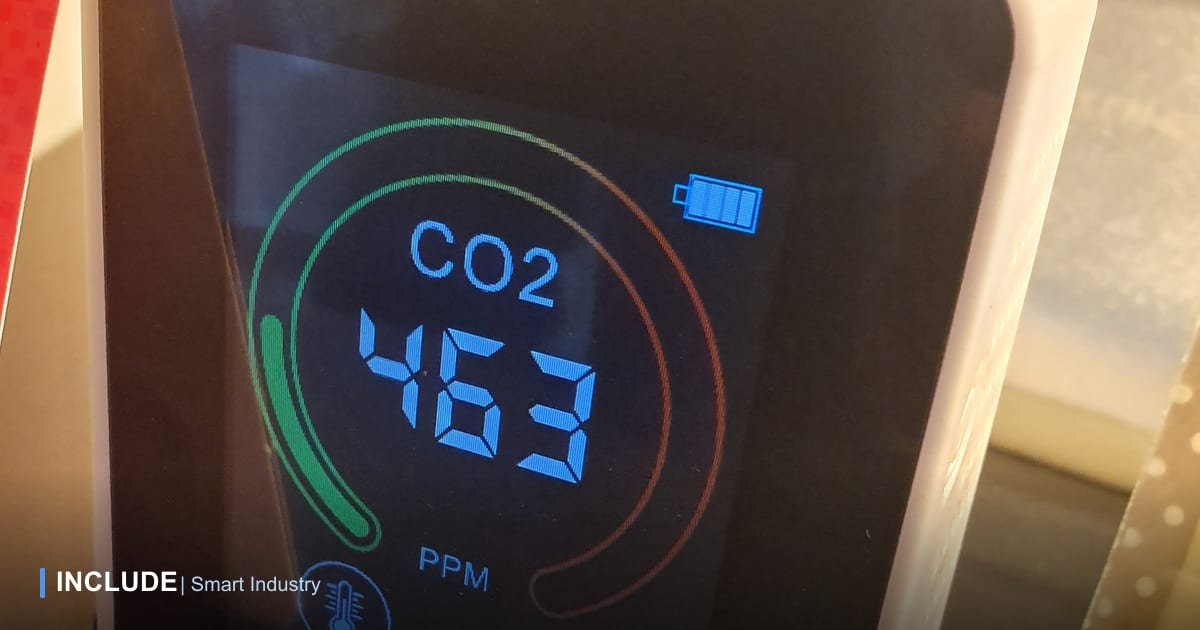
A meeting that starts fresh often ends with people yawning and struggling to focus. The cause is not always the agenda; it may be the air. In a closed room full of people, CO2 can pass 2,000 ppm within an hour without anyone noticing.
Indoor CO2 levels are the simplest way to tell whether the air in a room is being replaced often enough. This guide covers the safe limit in Indonesian regulations, a worked meeting room example, and how to choose, place, and read a CO2 sensor.
Why CO2 is used to judge air quality
Everyone exhales CO2. If too little fresh air enters a room, that CO2 builds up. It rises with the number of occupants and falls with the amount of fresh air, which makes it a useful indicator of ventilation.
At the levels usually found in offices, CO2 is not toxic. The problem is that odours, moisture, and fine particles from other people's breath build up with it. Indonesia's Ministry of Health Regulation 1077/2011 also states that CO2 above the threshold can cause drowsiness, headaches, and reduced physical activity.
Indoor CO2 limits in Indonesian regulations
Two Ministry of Health regulations use the same figure, 1,000 ppm (parts per million):
| Reference | CO2 limit | Notes |
|---|---|---|
| Outdoor air (current global average) | About 420 to 430 ppm | Can be higher near busy roads |
| Regulation 48/2016 on office occupational health and safety | Maximum 1,000 ppm | Also sets workroom temperature at 23 to 26 °C and humidity at 40 to 60% |
| Regulation 1077/2011 on indoor air in homes | Maximum 1,000 ppm | 8-hour average |
Regulation 48/2016 also sets fresh air requirements: 0.57 m³ per person per minute for workrooms and 1.05 m³ per person per minute for meeting rooms.
A rough guide for reading a dashboard (not part of the regulations):
- Below 800 ppm: good ventilation.
- 800 to 1,000 ppm: under the limit, but worth watching.
- Above 1,000 ppm: over the regulatory limit. More fresh air is needed.
- Above 2,000 ppm: ventilation is very poor and needs fixing the same day.
Where indoor CO2 comes from
The main source is the occupants' breath. An adult doing seated work exhales about 18 litres of CO2 per hour. Split air conditioners, which most offices in Indonesia use, only cool and recirculate the air inside the room without bringing in outdoor air. With doors and windows shut, fresh air only comes through door gaps, which is far from enough for a full room.
Worked example: a 12-person meeting room
The figures below are an illustration based on assumptions, not measurements. Use your own room size and headcount.
| Item | Value |
|---|---|
| Room size | 6 x 5 m, 3 m high (90 m³) |
| Number of people | 12 |
| Assumed CO2 exhaled per person | 18 litres per hour |
| Total CO2 from occupants (12 x 18 litres) | 216 litres per hour |
| Assumed fresh air entering (door shut, split AC) | 45 m³ per hour |
| Starting CO2 (same as outdoors) | 420 ppm |
| Time to reach 1,000 ppm | About 15 minutes |
| CO2 after 1 hour | About 2,300 ppm |
| Fresh air needed to stay below 1,000 ppm | About 370 m³ per hour |
This meeting room passes the regulatory limit a quarter of an hour after the meeting starts. With fresh air at the meeting room requirement in Regulation 48/2016 (1.05 m³ per person per minute), CO2 in the same room would hold at around 700 ppm.
Choosing an indoor CO2 sensor
- Choose an NDIR sensor. An NDIR (non-dispersive infrared) sensor measures CO2 directly from how much infrared light it absorbs. Avoid sensors that only show "eCO2". Those estimate CO2 from organic gases (VOCs), so the figure can be far off.
- Check the accuracy. For rooms, an accuracy of about ±50 ppm is enough. A range of 0 to 5,000 ppm covers almost any building.
- Understand automatic calibration. Many NDIR sensors assume the lowest reading over several days equals outdoor air. That works in offices that empty out every night, but in rooms occupied around the clock, such as control rooms, readings can drift too low. In those rooms, calibrate manually at regular intervals.
- Choose one that sends data. A sensor with only a display is seen only by whoever walks past. A sensor with Modbus RTU output or a wireless connection can log data continuously, trigger alarms, and often reads temperature and humidity too.
Where to place a CO2 sensor
- At breathing height, about 1 to 1.5 metres above the floor, on an inside wall.
- Away from doors, windows, and AC outlets. Direct airflow makes the reading unrepresentative.
- Not right in front of someone's face, such as on a desk. Direct breath makes the reading spike.
- One sensor per enclosed room. In open-plan offices, fit one sensor per area with a similar number of people.
- Log every 1 to 5 minutes. CO2 in a meeting room rises within minutes, so hourly readings will miss the peak.
Reading CO2 data day to day
- Rises fast in every meeting, falls slowly afterwards. The room depends on door gaps. Add fresh air or leave breaks between meetings.
- Never falls close to outdoor levels, even in the morning. Mechanical ventilation is probably off, the outdoor air damper is closed, or the filter is clogged.
- Flat near outdoor levels all day. The room is rarely used, so check that its AC is not running for nothing.
Compared with AC power, rooms where the AC runs while empty stand out straight away. The full discussion is in the guide to saving energy on office air conditioning.
What to do when CO2 is high
- Add fresh air, not just a lower AC setpoint: a fresh air fan, an energy recovery ventilator (ERV) that saves part of the cooling energy, or natural ventilation.
- Open doors and windows from time to time. Regulation 48/2016 advises periodic natural air exchange in air-conditioned rooms, by opening doors and windows or using fans.
- Match meeting room capacity to the fresh air available.
- Supply fresh air on demand. Hot, humid outdoor air adds to the AC load. With CO2 data per room, fresh air can be increased when a room is full and reduced when it is empty.
Frequently asked questions
Is 1,000 ppm of CO2 dangerous?
No, CO2 is not toxic at that level. The 1,000 ppm limit is a marker of poor ventilation. According to Regulation 1077/2011, more serious effects only start at around 30,000 ppm.
Can an air purifier lower CO2?
No. Filters such as HEPA capture particles, not CO2 gas. CO2 only falls when indoor air is replaced with outdoor air.
Are indoor plants enough to lower CO2?
Their effect is very small compared with the CO2 exhaled by people in the same room. Plants cannot replace ventilation.
How many CO2 sensors does a building need?
One for each enclosed room and one per area in open-plan offices. Start with the most crowded rooms.
Monitor CO2 room by room with InBuilding
The InBuilding solution on the INCLUDE platform shows CO2, temperature, and occupancy for every room in real time on one dashboard. Its space analytics summarise each room's high-CO2 hours and utilisation. When AC power is monitored too, InBuilding also flags the hours when AC runs in an empty room, with an estimate of the kWh wasted.
Room sensors with Modbus RTU output can be read through IncludeGateways, and CO2 alarm limits are set on the platform. To keep alarms from firing too often, read the guide to sensor alarm thresholds. InBuilding is available from the Pro plan; details are on the pricing page.
Want to know which rooms have the stuffiest air?
Tell us how many rooms and what kind of AC your building has. The INCLUDE team will help set up CO2 monitoring room by room.
Free consultation on WhatsApp → See the InBuilding solution →