

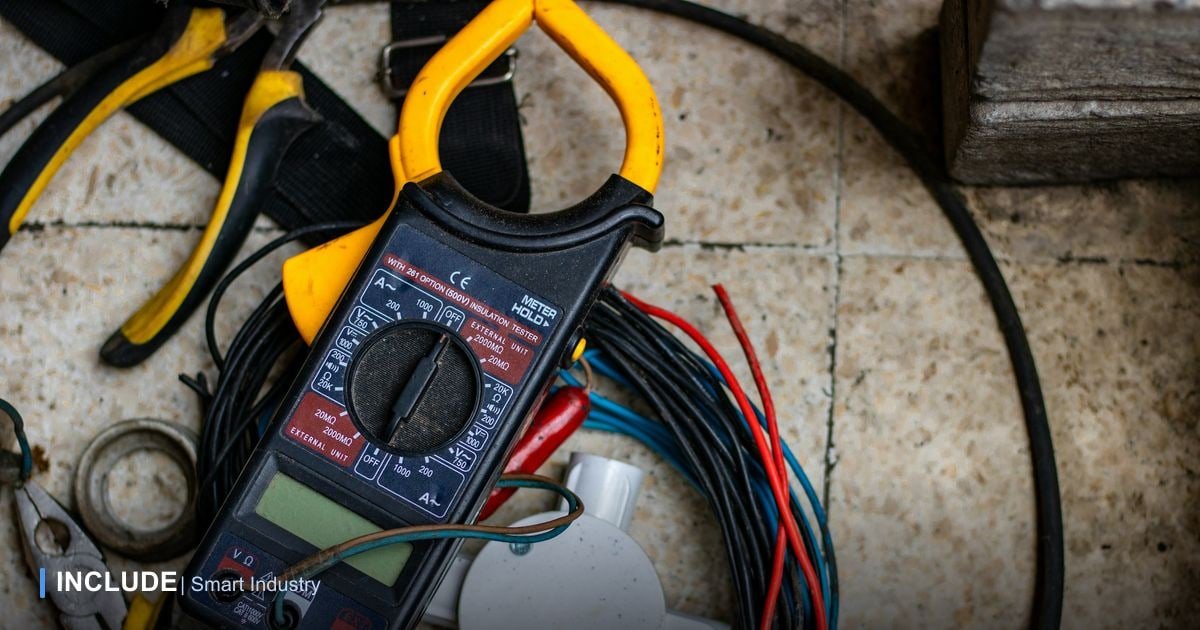
The capacitor bank fuses keep blowing. The transformer runs hot although its load is under the rating. The neutral cable is warmer than the phases. Yet a clamp meter shows nothing unusual.
Symptoms like these are often caused by industrial power harmonics: distortion of the current and voltage waveform by electronic loads such as variable frequency drives (VFDs), UPS units, and welders. This guide covers the causes, the effects on machines and transformers, reference limits, and how to monitor THD (total harmonic distortion) continuously with a power meter.
What industrial power harmonics are
Grid power is ideally a 50 Hz sine wave. Linear loads, such as resistive heaters, draw current that stays sinusoidal. Non-linear loads draw current in short pulses, so the waveform is no longer a sine.
That distorted wave is made of the 50 Hz fundamental plus its multiples: the 3rd harmonic (150 Hz), the 5th (250 Hz), the 7th (350 Hz), and so on. As harmonic current flows through the impedance of cables and transformers, the voltage becomes distorted too, and every other device on the panel has to run on it.
Where harmonics come from in a plant
- VFDs on pumps, fans, compressors, and conveyors. Drives with a 6-pulse rectifier typically produce the 5th, 7th, 11th, and 13th harmonics.
- UPS units, battery chargers, and DC rectifiers.
- Welders and induction furnaces.
- Single-phase electronic loads such as LED lighting, computers, and switch-mode power supplies, mainly producing the 3rd harmonic.
Ironically, VFDs fitted to save energy are themselves harmonic sources, so each new drive adds distortion unless it is planned.
What harmonics do to machines and transformers
- Transformers run hotter. Harmonic currents raise eddy current losses in the windings, and those losses climb steeply with harmonic order. A transformer can overheat below its kVA rating and may need derating.
- Neutral current rises. In four-wire systems, 3rd harmonics from the three phases add up in the neutral instead of cancelling, so neutral current can exceed phase current. Three-phase load imbalance also raises neutral current, so the data needs to separate the two.
- Capacitor banks fail or resonate. Capacitor impedance falls at higher frequencies, so capacitors absorb harmonic current and heat up. They can also resonate with transformer inductance and amplify a particular harmonic. Typical signs are blown fuses and bulging capacitors.
- Motors run hotter and noisier on distorted voltage.
- Protection and meters misbehave. Breakers trip for no clear reason, and meters that are not true RMS can read wrong, usually lower than the real current.
Current THD and voltage THD
THD is the RMS value of all harmonic components relative to the fundamental, as a percentage. Two kinds matter:
- Current THD (THDi) shows how distorted a load's current is. This is the cause. A VFD without a reactor can reach tens of percent.
- Voltage THD (THDv) shows how distorted the voltage on a panel is. This is the effect, since every device on that panel shares it.
High THDi is not always a big problem. As an illustration, 40% THDi on a lightly loaded drive with a 10 A fundamental is only about 4 A of harmonic current. That is why TDD (total demand distortion) exists: it compares harmonic current with the maximum load current instead.
Common reference limits
PLN has its own standard, SPLN D5.004-1:2012, covering harmonics, flicker, and voltage unbalance. Engineering studies also widely use IEEE 519 as a benchmark. For voltage, IEEE 519-2014 sets these limits at the point of common coupling (PCC):
| Voltage at the connection point | Individual harmonic | Voltage THD |
|---|---|---|
| Up to 1 kV | 5% | 8% |
| Above 1 kV up to 69 kV | 3% | 5% |
Current limits depend on the short-circuit ratio at each site. Note two things: the limits apply where the plant meets the grid, not at each machine, and the assessment is statistical (10-minute values over a week, 95th percentile), not one instant reading. Confirm the limits for your connection with PLN and an electrical engineer.
How to monitor THD with a power meter
A spot check suits a first survey, but harmonics shift with the load. Continuous monitoring shows when distortion peaks and what was running then.
- Choose a power meter that measures harmonics. Not every energy meter does. Look for voltage and current THD per phase, ideally individual harmonics too. Measurement methods are defined in IEC 61000-4-7, and power quality instrument classes in IEC 61000-4-30.
- Pick measuring points: the main incomer, panels with many VFDs, the capacitor bank feeder, and the neutral on panels with many single-phase loads. The logic matches electrical submetering.
- Record it with other data such as kW, power factor, phase currents, and neutral current. A one to ten minute interval is enough for daily patterns.
- Bring it into one place. Many digital power meters expose THD registers over Modbus, which a gateway can read and send to a monitoring platform.
- Set alarms for when main panel voltage THD nears the reference limit, neutral current nears phase current, or current THD on the capacitor feeder rises above normal.
How to reduce harmonics
- Measure before buying a filter, so the biggest sources are known and harmonics are confirmed as the problem.
- Add reactors to VFDs (a line reactor or DC choke). It is relatively cheap and clearly lowers current THD.
- Use detuned capacitor banks (with reactors) on panels with many non-linear loads to avoid resonance. The power factor side is covered in our article on kVArh charges and low power factor.
- Consider passive or active filters if a panel still exceeds the limits. Choosing one calls for a harmonic study by an electrical engineer.
- Check neutrals and transformers, then measure again for several days to prove the result.
Things to keep in mind
- Basic energy meters do not measure THD. Check the specification before relying on one.
- CTs affect accuracy. Oversized or low-class current transformers make harmonic readings less reliable.
- Permanent monitoring does not replace a power quality survey for designing filters or proving compliance; it catches changes and proves fixes work.
- Live panel work is for competent technicians following safety procedures.
Frequently asked questions
Do harmonics increase the electricity bill?
A PLN bill usually has no separate line for harmonics. But extra losses in cables and transformers downstream of the PLN meter are recorded as kWh, and damaged capacitor banks can let power factor drop until excess kVArh charges appear.
Why is power factor still low when the capacitor bank works?
With harmonics, true power factor depends on both phase displacement and distortion. A capacitor bank only corrects displacement. Some power meters show both separately as displacement power factor and true power factor.
Does every VFD need a harmonic filter?
Not always. A few small drives on a large transformer often cause no trouble. THD data per panel shows where reactors or filters are really needed.
Monitoring power harmonics with INCLUDE
InEnergy monitors voltage, current, power, energy, and power factor per meter in real time, with cost per device and alarms. To be clear: the IncludeBox Energy Meter reads those parameters but does not measure THD.
For harmonics, a power meter that measures THD and supports Modbus can connect through IncludeGateways. THD and neutral current then appear as charts next to your energy data, each with its own safe range. When a value leaves it, an alarm appears and can be forwarded to Telegram, so a THD rise after a new drive goes in shows up the same day, not after the capacitor bank fails.
Capacitor fuses keep blowing or a transformer runs hot for no clear reason?
Tell us how many VFDs you run, your main panels, and the power meters already installed. The INCLUDE team will help choose THD measuring points and how to connect them.
Free consultation on WhatsApp → See InEnergy →