

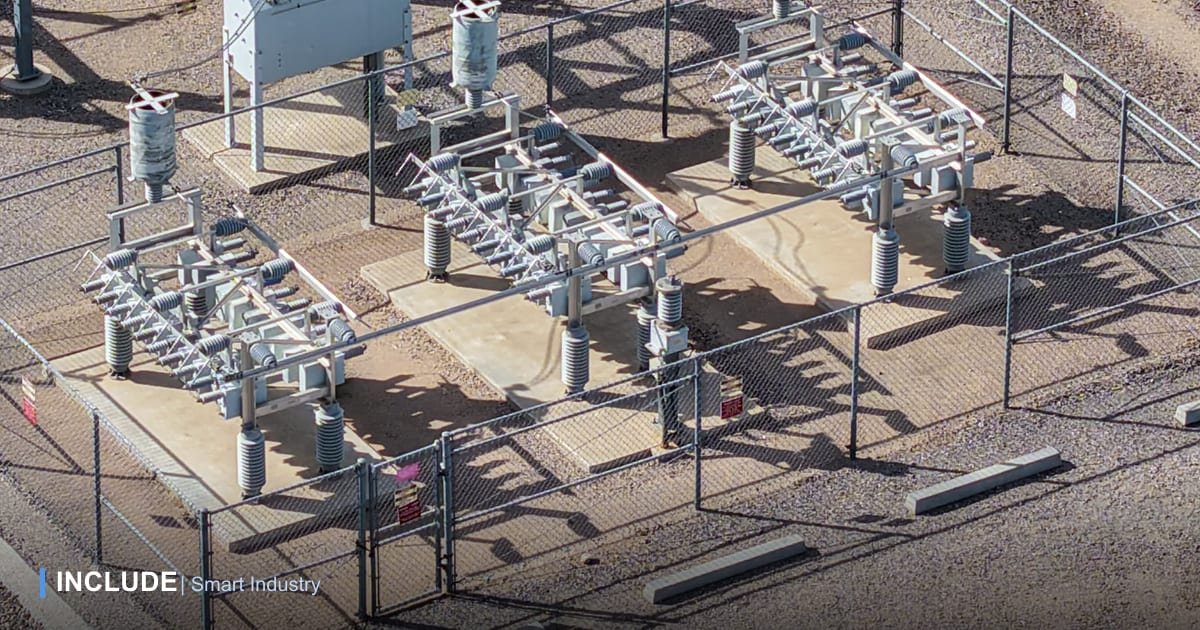
There is one line on an industrial electricity bill that often goes unnoticed: the charge for excess reactive energy, usually called the kVArh penalty. It appears when a plant's average power factor for the month falls below 0.85. The amount can be small, or it can run into millions of rupiah a month, and it is usually only noticed once the bill arrives.
The good news is that low power factor can almost always be fixed, and its cause can be traced if the data exists. This article explains how PLN calculates the kVArh charge, what pulls power factor down, and how to monitor it before the next bill.
What power factor is, and why PLN charges for kVArh
Motors, transformers, compressors, and welders do not only draw active power (kW), the power that does useful work. They also draw reactive power (kVAr) to build magnetic fields. Reactive power does no work, but it still flows through PLN cables and transformers, loading the grid.
Power factor is the ratio of active power to total power. A value of 1 means all power goes into work. The lower it gets, the larger the reactive share. That is why PLN's tariff rules charge certain customer groups (typically business and industry) for excess kVArh when the monthly average power factor is below 0.85.
How excess kVArh is calculated
At a power factor of 0.85, the ratio of kVArh to kWh is about 0.62. That is the threshold: any kVArh above 0.62 × kWh in a month counts as excess, and is multiplied by the kVArh rate for your tariff group (shown on the bill).
An illustrative example, with assumptions:
- Monthly consumption of 100,000 kWh at an average power factor of 0.80.
- At 0.80, kVArh is about 0.75 × kWh, so 75,000 kVArh.
- The free allowance: 0.62 × 100,000 = 62,000 kVArh.
- Excess: 75,000 − 62,000 = 13,000 kVArh.
- Assuming a kVArh rate of Rp1,100, the charge is about Rp14.3 million for that month.
The figures are only an illustration. The pattern is what matters: a gap that looks small (0.80 against 0.85) is enough to create a charge that repeats every month.
Common causes of low power factor in plants
- Induction motors running far below their rating. A 30 kW motor driving a 10 kW load has a much worse power factor than it does near full load.
- A capacitor bank that is damaged or not switching in. A blown fuse, capacitors that have lost capacity with age, or a stuck step on the APFC (automatic power factor controller) panel. This is the most commonly missed cause, because the panel still looks installed.
- New machines added without recalculating compensation. The capacitor bank was sized for the old load. A new line adds reactive power, but the compensation stays the same.
- Loads with high harmonics. Variable speed drives, welders, and electronic loads add distortion. Here, adding ordinary capacitors can make things worse; a detuned capacitor bank with reactors is usually needed.
- Operation outside working hours. When production stops but transformers, compressors, or HVAC keep running at light load, power factor drops too.
Why a monthly check is not enough
The PLN bill only shows a monthly average from the main meter. You know power factor dropped, but not when or where. Does it drop every night? Only when one particular line runs? Ever since the third capacitor step stopped working two weeks ago?
Those questions can only be answered with hourly data, ideally per panel or per line. Modern energy meters already measure power factor alongside voltage, current, and power. What is usually missing is one place to see all those numbers together, with history and alarms.
Steps to fix it and prevent the charge
- Measure first, per panel. Put three-phase energy meters on the main panel and the largest line panels. This shows which panel contributes the most reactive power.
- Check the existing capacitor bank. The fix is often not new capacitors but repairing dead steps or replacing degraded units.
- Recalculate the compensation you need once you have real load data, especially after adding machines or high-harmonic loads.
- Set an alarm above 0.85, for example at 0.88, so there is time to act before the monthly average falls into the penalty zone.
- Review every month by comparing daily power factor with the bill, so the improvement shows up in the invoice.
Monitoring power factor with InEnergy
InEnergy shows voltage, current, power, and power factor per meter in real time, with full history. You can set a power factor alarm per panel, so a drop is visible the same day, not at the end of the month. The data can come from an IncludeBox Energy Meter, or from power meters already on site via Modbus and IncludeGateways.
The same data is used to control load during peak hours, covered in our article on cutting electricity cost during WBP peak hours. The kVArh charge and the peak-load charge are two different lines on the bill, but both can be watched from one dashboard.
Does your electricity bill include an excess kVArh charge?
Tell us your tariff group and how many panels your plant has. The INCLUDE team will help pick the measurement points that matter most.
Free consultation on WhatsApp → See InEnergy →