

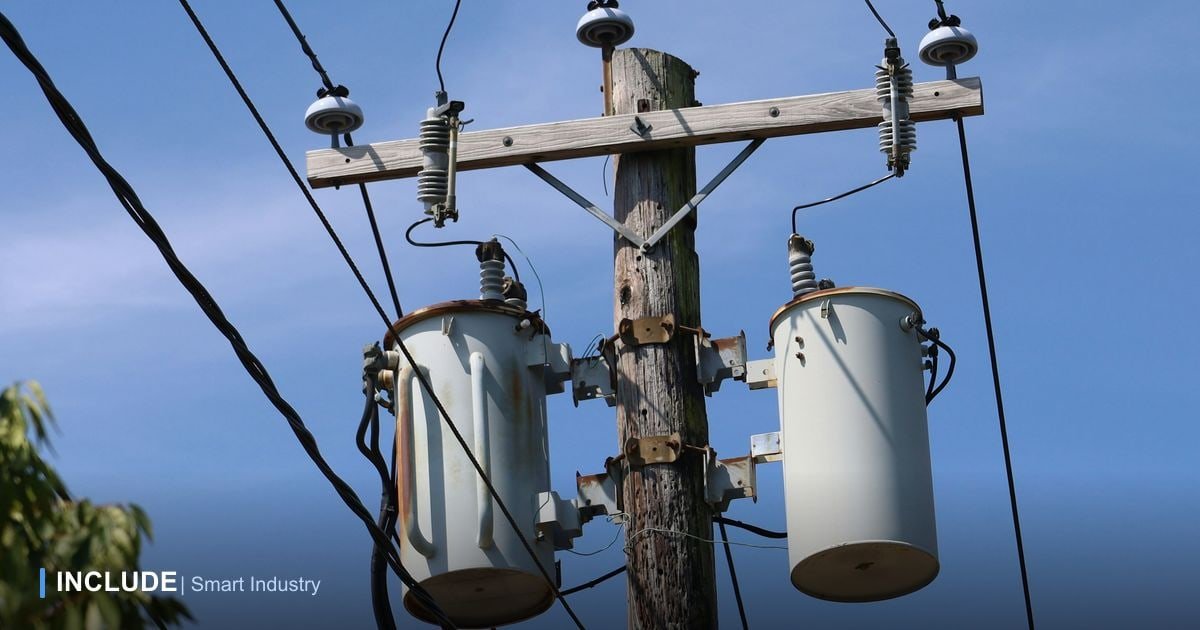
A distribution transformer gets little attention until it stops. When it fails, every panel behind it goes dark, and replacing it takes far longer than a day. Yet most transformers warn you long before they fail, mostly through heat.
Transformer temperature monitoring turns that warning into data: load per phase, oil or winding temperature, and room temperature, logged continuously against their limits. This guide covers why heat sets transformer life, the warning signs, what add-on sensors and power meters can measure, and how to set alarms.
Why heat decides transformer life
A transformer lasts as long as its insulation. The windings are wrapped in oil-impregnated paper (oil-filled units) or cast in resin (dry-type units), and that insulation ages faster when hot. The IEC 60076-7 loading guide for oil-immersed transformers uses a simple rule of thumb: for ordinary insulating paper, every rise of about 6°C in the winding hot-spot temperature doubles the ageing rate.
Core losses stay almost constant while the transformer is energised, but winding losses rise with the square of the current: a 120% load produces about 1.44 times the winding loss at rated load. A modest overload can push temperatures up a long way, especially in a hot, poorly ventilated room.
Load, oil temperature, and winding temperature
- Load is the current drawn as a percentage of rated current. It is the main cause of heating and the easiest thing to measure.
- Top-oil temperature is taken at the top of the tank, where the hottest oil collects. It changes over hours, which makes it good for trends.
- Winding hot-spot temperature drives insulation ageing but is rarely measured directly; it is usually estimated from top-oil temperature plus a load-dependent gradient. Dry-type units often have PT100 sensors embedded in the windings.
Larger oil-filled units usually have an oil temperature indicator (OTI) and a winding temperature indicator (WTI) with alarm and trip contacts. Smaller distribution units often have only an oil thermometer, or none.
Warning signs before a transformer fails
- Oil running hotter than usual at the same load, which points to a cooling problem: dirty radiator fins, a failed fan, a blocked vent, or low oil.
- Load above rating for hours, often when the busiest shift meets a hot afternoon.
- One phase carrying far more current than the others. The heaviest phase heats its own winding even when total kVA looks safe. See our article on three-phase load imbalance.
- Hot connections at bushings, cable lugs, or busbars, often from loose bolts.
- Physical signs: oil seepage or a falling oil level, breather silica gel changing colour, louder humming, or a burning smell.
- Worsening oil test results, such as rising moisture or dissolved gas analysis (DGA) showing gases linked to overheating.
What add-on sensors and power meters can measure
A transformer in service for years can still be monitored without replacing it. The usual measuring points:
| What is measured | Instrument | What it tells you |
|---|---|---|
| Phase currents, voltage, kW, kVA, power factor | Main-panel power meter, often already installed | Load percentage, load profile, imbalance |
| Neutral current | A power meter that measures neutral, or an extra CT | Imbalance and non-linear loads |
| Top-oil temperature | OTI output if available, or a PT100 sensor with a transmitter | Temperature trend against load |
| Winding temperature (dry-type) | Built-in temperature relay with PT100 sensors; some have an RS-485 port | Temperature per winding, fan status |
| Room temperature | Room temperature sensor | Telling overload apart from poor ventilation |
| Alarm and trip status | OTI, WTI, Buchholz relay, or pressure relief contacts wired to a digital input module | A record of when protection operated |
Simple sensors cannot reach the true hot-spot temperature (that needs fibre-optic probes fitted at the factory), the paper insulation, or the gases in the oil, so periodic laboratory tests are still needed. Those tests happen a few times a year; monitoring runs every minute.
Working out transformer load percentage
Rated secondary current comes from the transformer rating: rated current = kVA x 1,000 / (1.732 x line-to-line voltage). As an illustration, a 1,000 kVA transformer with a 400 V secondary has a rated current of about 1,443 A. If the power meter records a peak of 1,150 A on one phase, that phase is loaded to about 80%.
Use the phase with the highest current, not the three-phase average, because that phase runs hottest. Log the profile every 1 to 15 minutes to see when load peaks and how long it lasts. Meter placement follows the same logic as electrical submetering.
Setting alarms that fire before failure
Useful alarms are tiered and leave time to act. The figures below are examples only; real limits come from the manufacturer's data and your electrical engineer.
- Load warning, for example above 80% of rating on the highest phase, while there is still time to shift load.
- Overload alarm, for example above 100% of rating, especially if it persists.
- Oil temperature warning a few degrees below the OTI alarm setting, so monitoring reacts before protection does.
- Trend alarm: the gap between oil and room temperature at a similar load creeping up week by week, often the earliest sign of a cooling problem.
- No-data alarm, so a dead sensor or lost connection is never mistaken for a safe reading.
Monitoring complements protection rather than replacing it; tripping remains the job of the protection relays. Setting thresholds that avoid constant false alarms is covered in our guide to sensor alarm thresholds.
Things to keep in mind
- Safety first. Sensors and CTs on transformers and panels must be fitted by competent technicians under proper isolation procedures.
- Tank surface sensors read lower than the actual oil temperature. Use them for trends, not for direct comparison with the OTI setting.
- Get the CT ratio right. A wrong ratio throws the load percentage far off, so check the first readings with a portable instrument.
Frequently asked questions
What is a normal transformer oil temperature?
There is no single figure; it depends on design, load, and ambient temperature. Use the manufacturer data and OTI settings, plus the pattern of your own transformer at the same load. A rise above that pattern matters more than any single reading.
Can a transformer run above 100% load?
For limited periods an oil-filled transformer can carry more than its rating if it was cool beforehand, at the cost of faster insulation ageing. Limits and duration have to be worked out per unit with the manufacturer or an electrical engineer.
Our transformer has no thermometer. Where do we start?
Start with load: the main-panel power meter is often already there. Load per phase and room temperature give the big picture, and an oil temperature sensor can follow at the next planned outage.
Transformer temperature monitoring with INCLUDE
InEnergy monitors voltage and current on each phase, power, energy, frequency, and power factor per meter, with load profiles and alarms. The IncludeBox three-phase Energy Meter handles up to 200 A per phase, enough for sub-panels and small transformers. For larger transformers, a main-panel power meter with Modbus RTU is read through IncludeGateways, as are temperature transmitters and dry-type temperature relays with a Modbus RTU (RS-485) port.
In InAsset, a transformer can be an asset with its own temperature chart, service schedule, and an alarm when temperature leaves the safe range you define. To be clear, InAsset's days-to-failure estimate is based on vibration trends in rotating machines, so for transformers the value lies in temperature tracking, alarms, and service schedules. Alarms can go to Telegram, so a night-time temperature rise does not wait for the morning round.
Transformer running hot, or load close to capacity?
Tell us the transformer rating, its type (oil-filled or dry), and the power meters already installed. The INCLUDE team will help choose measuring points and sensible alarms.
Free consultation on WhatsApp → See InEnergy →