

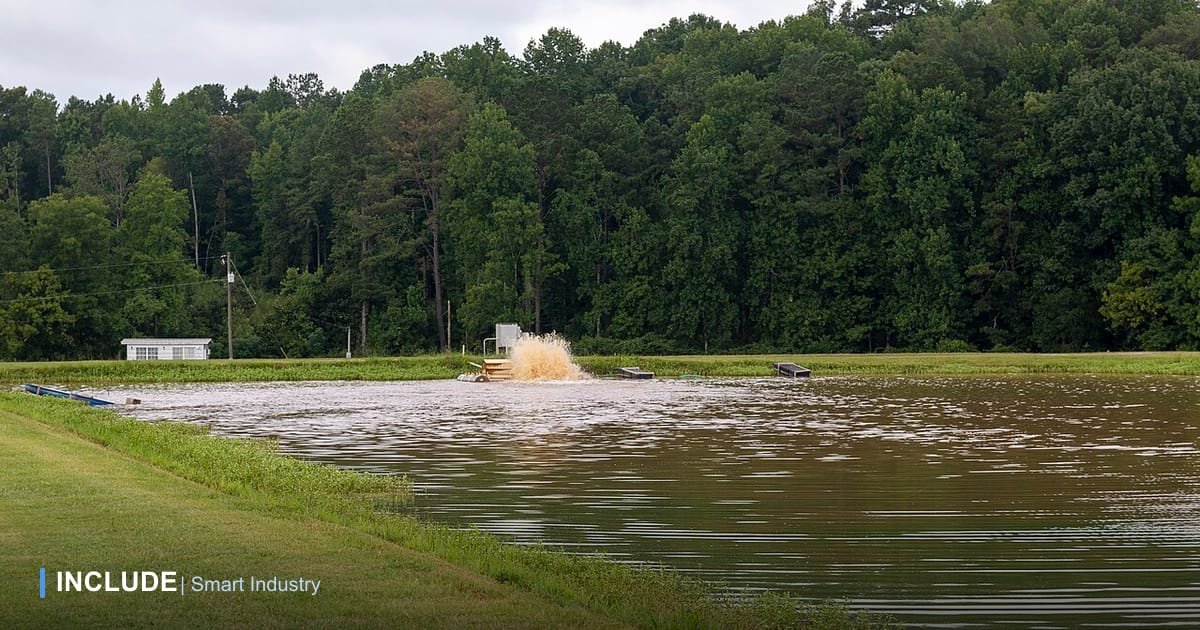
In shrimp and fish farming, water quality decides almost everything: growth, health, and survival. The problem is that conditions can change fast, often during hours when nobody is watching. Dissolved oxygen crashing before dawn, pH swinging after heavy rain, or ammonia slowly building up can lead to mass mortality before anyone sees it.
Manual measurement a few times a day is still common, but the gaps are large. This article covers the most important pond water quality parameters and how continuous monitoring provides early warning.
Dissolved oxygen (DO): the most critical parameter
During the day, phytoplankton produce oxygen through photosynthesis. At night, photosynthesis stops while shrimp, fish, plankton, and bacteria keep consuming oxygen. As a result, DO is usually at its lowest just before sunrise. Many shrimp farming guides recommend keeping DO above about 4 mg/L; below that, stock begins to stress, and further drops can be fatal.
Because the critical point comes before dawn, a manual morning reading is often already too late. Continuous monitoring catches the drop while it can still be handled, for example by switching on extra aerators.
Other parameters to monitor
- pH. Rises by day and falls by night with photosynthesis. A daily swing that is too wide signals a plankton problem. Heavy rain can also lower pH suddenly.
- Water temperature. Affects appetite and oxygen demand. Warmer water holds less oxygen.
- Salinity. Can drop sharply after heavy rain, especially in shallow ponds.
- Ammonia. Comes from leftover feed and waste. The toxic share of ammonia rises with pH and temperature, so ammonia should always be read alongside both.
- Turbidity and TDS, as indicators of plankton density and dissolved particles.
From data to action
- Low-DO alarms sent to the pond keeper, with a threshold that leaves time to switch on extra aerators.
- Aerator automation based on DO, so aerators work harder when needed and do not waste power when oxygen is sufficient.
- Feed adjustment when DO or temperature is unfavourable, since excess feed in poor conditions only adds to the ammonia load.
- Records per cycle to compare water conditions with harvest results, so the next cycle can improve.
Installation challenges at ponds
- Sensor maintenance. Submerged sensors get coated in algae and biofilm. Schedule routine cleaning and periodic calibration as the manufacturer recommends.
- Sensor position. Avoid placing it right in front of an aerator or in a corner with still water, as readings will not represent the pond.
- Power and network. Many ponds are far from internet coverage. Cellular connectivity or a long-range gateway is often the answer.
Monitoring many ponds
On farms with many ponds, problems often appear in one pond first. A dashboard showing every pond side by side makes it easy to see which one is drifting from its normal pattern, so attention and labour go where they are needed.
Reading the daily DO pattern
A continuously recorded DO chart usually rises during the day and falls through the night. The pattern alone tells a lot:
- A low point that sinks lower day after day means the organic load is growing, for example from overfeeding or overly dense plankton.
- A day-night swing that keeps widening is often linked to a plankton bloom, which risks ending in a plankton die-off and a sharp DO crash.
- A drop after cloudy days happens because photosynthesis falls, leaving less oxygen in reserve for the night.
Aerators and the electricity bill
Aerators are often the largest electricity user on a farm. Running every aerator all day is safe but costly. With DO data, aerators can be added when oxygen falls and reduced when it is sufficient, for example on bright afternoons. The result is a balance between stock safety and electricity cost.
In the end, the goal of monitoring is not to collect as many numbers as possible, but to give the pond keeper time to act. One DO alarm arriving at three in the morning, while there is still time to start a backup aerator, can be worth more than a whole cycle of manual records. Start with the most critical parameter, make sure its alarm reaches the right person, then add others once the habit of using data is in place.
Frequently asked questions
When is DO lowest?
Usually just before sunrise, because oxygen is consumed all night with no photosynthesis to replace it.
Can sensors replace lab tests?
Not entirely. Sensors excel at continuous monitoring and early warning. Lab tests remain useful for more detailed parameters and for checking sensor accuracy.
How often do sensors need cleaning?
It depends on pond conditions and sensor type. Follow the manufacturer guidance, and watch for readings that slowly start to drift.
Monitoring water quality with INCLUDE
The IncludeBox Water Quality Sensor reads pH, dissolved oxygen, salinity, turbidity, TDS, ammonia, and water temperature, and sends them to the INCLUDE platform. Each parameter has an adjustable threshold, alarms go to the pond keeper, and aerators can be controlled through automation rules. For on-site weather data, the sensor can be combined with an automatic weather station.
Ever lost a harvest to a night-time DO crash?
Tell us how many ponds you run and what you farm. The INCLUDE team will help design water quality monitoring.
Free consultation on WhatsApp → See IncludeBox →