

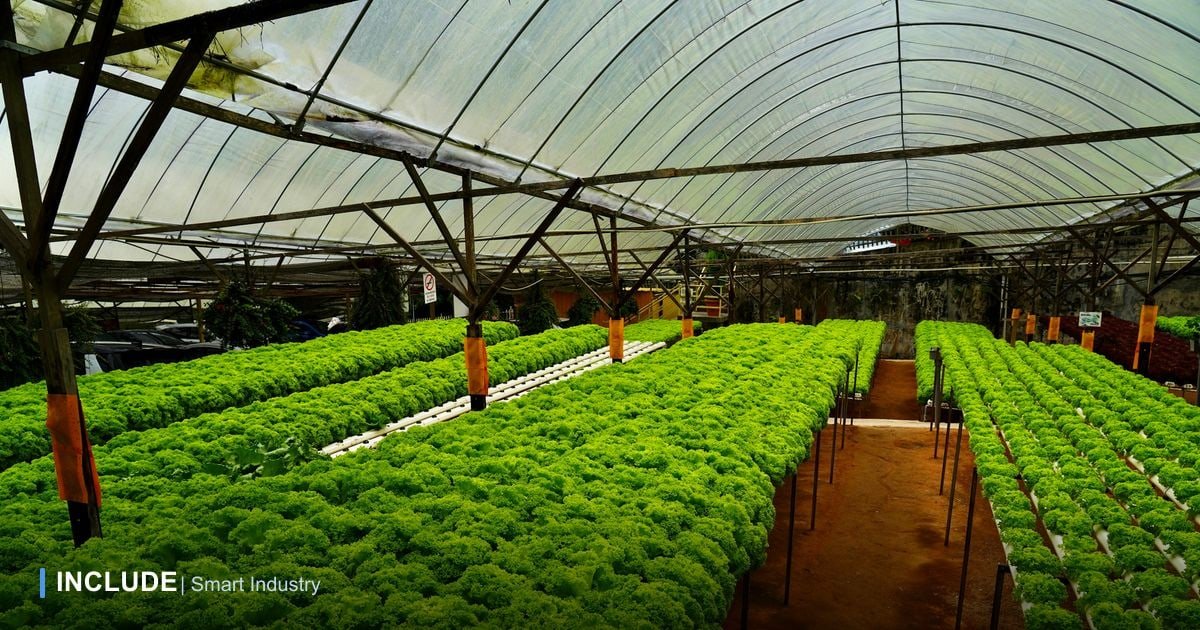
On many hydroponic farms, the nutrient solution is checked once a day with a TDS meter and a pH pen, and A/B nutrients are topped up by feel. The problem is that the solution keeps changing between checks. A hot afternoon makes it stronger, pH creeps up, and a pump that stops at midnight is only noticed the next morning when the leaves are already wilting.
Automated hydroponics closes that gap with sensors that read the solution continuously, alarms when a value leaves its range, and pumps that run on schedule. This guide covers how to read EC and pH, schedule pumps, set alarms, and which jobs are better left to people.
How automated hydroponics works
The pattern is always the same: measure, compare, act, record.
- Measure. Sensors in the reservoir read EC, pH, water temperature, and level, ideally dissolved oxygen too.
- Compare against the target range for the crop and its growth stage.
- Act: send an alarm, suggest an action, or run a pump on schedule.
- Record every reading, so daily patterns and the effect of each nutrient addition become visible.
The safe order is to automate measurement and alarms first, and actions later.
Reading EC and pH in a nutrient solution
EC (electrical conductivity) measures the strength of dissolved salts, nutrients included, usually in mS/cm. A TDS meter also measures EC, then converts it to ppm with a factor that varies by instrument, usually 0.5 or 0.7. A 1.0 mS/cm solution can read 500 ppm on one meter and 700 ppm on another, so make sure your meter uses the same scale as the recommendation you follow. EC also rises with water temperature, which is why good sensors use temperature compensation.
EC targets differ by crop and stage. Leafy greens are usually kept lower than fruiting tomatoes or melons. Start from your nutrient supplier's or extension officer's recommendation, then adjust based on how the crop responds.
pH decides whether nutrients can be absorbed. Agricultural extension guides generally put the range where most nutrients are available at pH 5.5 to 6.5. Outside it, plants can run short of certain elements even when EC is right. With fast-growing crops, solution pH tends to rise because roots take up a lot of nitrate.
What reservoir patterns mean
Continuous data beats a single morning reading, because the pattern points to the cause:
| Pattern | What it usually means | Action |
|---|---|---|
| Level falls, EC rises | Plants take up water faster than nutrients, typically on hot days | Add raw water, not nutrients |
| Level steady, EC falls | Nutrients are being used | Add A and B in equal doses |
| pH keeps rising | Nitrate uptake, or alkaline source water | Lower pH in small steps |
| Warm water, falling dissolved oxygen | Roots short of oxygen, higher root rot risk | Shade the reservoir, add aeration or circulation |
| Flat readings for days | The sensor may be fouled or stuck | Cross-check with a handheld meter |
Scheduling pumps for each system
- NFT. The thin film in the gullies must keep flowing. A pump that stops on a hot afternoon can dry the roots quickly, so level and pump failure alarms come first.
- DFT or floating raft. Roots sit in the solution, so plants tolerate a stopped pump better. The priority is oxygen: aerators or periodic circulation, more often when the water is warm.
- Drip irrigation in substrate such as cocopeat for melons and tomatoes. Irrigation cycles run on timers, closer together at midday. Measure the EC of the runoff too. If it is much higher than the EC you feed, salts are building up in the medium.
One caution: relay status only shows the pump has power, not that water is moving. A falling reservoir level or a flow sensor confirms it.
Alarms worth setting
- Low reservoir level, set early enough to refill before the pump runs dry. Measuring it is covered in our guide to tank water level sensors.
- EC and pH out of range. Add a delay after dosing so the solution can mix and the alarm does not fire for nothing.
- High water temperature and low dissolved oxygen. Water temperature follows the climate inside the growing house, covered in our guide to greenhouse monitoring with sensors.
- Data stopped arriving. A dead sensor or lost connection is as dangerous as a wrong reading.
Grade them: level and pump alarms are critical and should wake someone up, while slow EC or pH drift can be a warning. Our guide to sensor alarm thresholds explains how to avoid alarm fatigue.
What to automate and what to keep manual
- Automate: readings and logging, alarms, pump and aerator schedules, and raw water top-up with a float valve.
- Automate with care: dosing A/B nutrients and pH down with dosing pumps. It needs calibrated sensors, small doses, a mixing delay before the next reading, a daily dose limit, and an alarm when dosing happens too often. A drifting pH sensor can make a dosing pump keep adding acid.
- Keep manual: mixing stock solutions, calibrating and cleaning sensors, replacing the solution, inspecting roots and leaves, and decisions at crop changeover.
Things to keep in mind
- pH sensors need care. The electrode drifts over time and needs calibrating with buffer solutions as the manufacturer instructs.
- EC only measures the total. It cannot tell which element is short or in excess. An occasional lab test of the solution still helps, especially with well water.
- Water and electricity sit close together. Fit residual current protection on pump circuits and have a technician do the wiring.
- Automation stops in a power cut. For NFT, have a backup plan, and make sure the data-stopped alarm still gets through.
Frequently asked questions
Do we still need a handheld TDS meter?
Yes, as a cross-check. Installed sensors give trends and alarms, while a calibrated handheld meter confirms the sensor has not drifted.
When should the nutrient solution be replaced completely?
It depends on the system and the source water. Signs include EC that keeps rising even after adding raw water, or deficiency symptoms while EC and pH look right. Historical data helps set the schedule.
Does every hydroponic farm need automatic dosing?
No. On a small farm, timely advice is often enough: the operator knows when to add raw water, nutrients, or pH down. Dosing pumps make more sense for large reservoirs or many tanks.
Automated hydroponics with INCLUDE
InFarmer reads the nutrient reservoir continuously: strength in ppm and EC, pH, water temperature, dissolved oxygen, and tank level. Every value appears with its target range, including per-crop ranges for lettuce, pak choi, tomato, and melon. Each drift comes with the action to take: how much raw water to add, when to add A/B nutrients, and when to lower pH. Low reservoir level is flagged before the pump runs dry.
The InFarmer page also includes an Automation section. For pumps, smart switches on the INCLUDE platform can switch loads of up to 10 A per channel on, off, or on a schedule. Larger pumps, or pumps with a high starting current, should still go through a contactor in a panel. Telegram alarm forwarding and Rule Chain for your own automation logic come with the Pro plan and above. Your own sensors can also send data over MQTT or HTTP.
Still checking the nutrient solution once a day?
Tell us about your hydroponic system, how many reservoirs you run, and your crops. The INCLUDE team will help decide which sensors and alarms to install first.
Free consultation on WhatsApp → See InFarmer →