

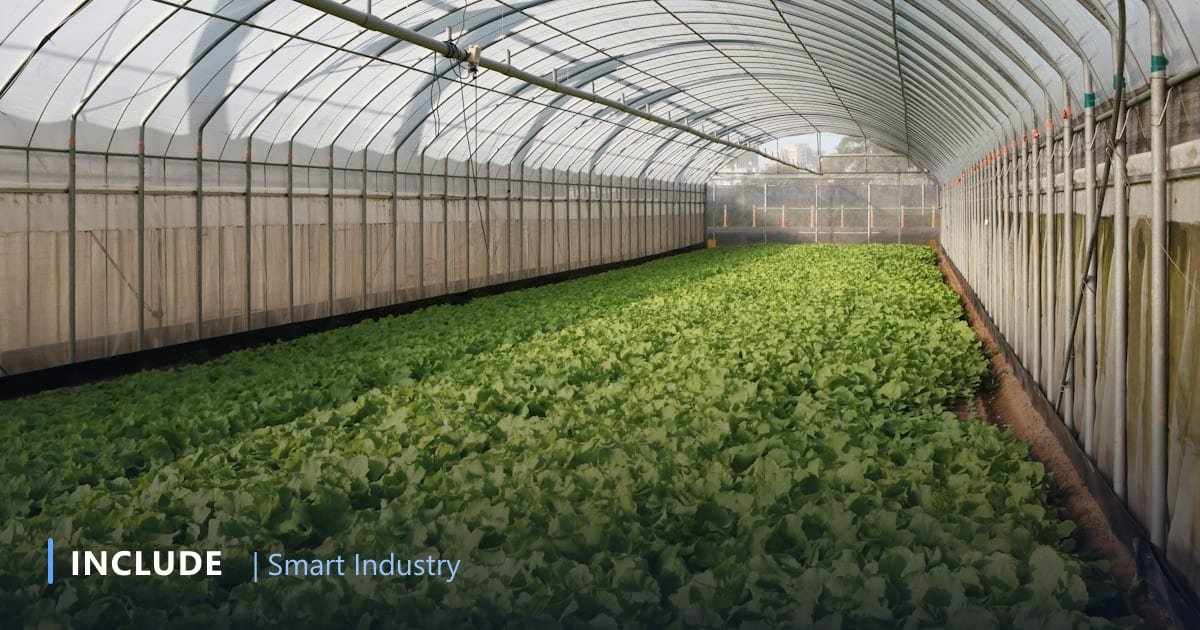
In most horticultural greenhouses, irrigation still runs on the clock: twice a day, fixed duration, whatever the weather. The outcome can be bad in both directions, overwatering on overcast days, leaving roots prone to rot, and underwatering when solar radiation is high, stunting growth. Both cut yield, and neither is visible until symptoms show on the leaves.
The problem isn't the schedule, it's the missing feedback
An irrigation schedule is a guess made once and then repeated indefinitely. It doesn't know that today clouded over at noon, that ambient humidity is at 85%, or that the substrate in block B is still saturated from the previous cycle. Without feedback, watering decisions rest on the operator's experience, valuable, but hard to scale across blocks and impossible to audit.
The costs compound: more water and fertiliser than needed, uneven growth between blocks, and most expensive of all, a yield drop whose cause is only diagnosed after harvest.
Four parameters that decide most of it
You don't need dozens of sensor types. For most horticultural crops, these four explain the majority of daily decisions:
- Substrate moisture: the most direct input for irrigation decisions. Place it in the root zone, ideally at two depths, so you can see whether water truly infiltrates or only wets the surface.
- Air temperature and humidity: these drive transpiration. High temperature with low humidity means plants lose water far faster; warm air with very high humidity instead raises fungal disease risk.
- Light intensity: the best predictor of daily water demand. A clear day and an overcast day call for markedly different volumes.
- Nutrient solution EC and pH: for fertigation systems. Drifting EC means the fertiliser concentration is off target; pH outside range blocks nutrient uptake even when the nutrients are present.
How InFarmer turns readings into action
InFarmer is the agriculture monitoring platform in INCLUDE. What separates it from a plain data logger is what happens to the data:
- Multi-block monitoring on one screen. Every greenhouse or block sits side by side, so an anomaly in one is visible immediately without walking the site.
- Threshold-based alerts. Notifications fire when substrate moisture drops below the limit, temperature crosses a critical point, or EC drifts off target, including overnight when nobody is on site.
- Traceable history. When one block underperforms, the season's temperature, humidity, and irrigation history shows exactly when conditions went off track.
- Season-over-season comparison. Practices that worked become numbers rather than recollections, so they can be replicated across blocks.
Five common mistakes on first installation
Most disappointment with greenhouse monitoring comes not from the hardware but from how it was installed. The recurring ones:
- Placing sensors where they don't represent anything. A temperature sensor in direct sunlight reads far higher than what the crop experiences. Mount it inside a radiation shield, at canopy height.
- One measurement point per greenhouse. Near the door, near the fan, and mid-span can differ by several degrees. For long structures, two points are far more informative than one.
- Substrate probes with poor contact. Air gaps around the probe produce readings that are too dry and unstable. Seat it firmly in the medium and re-check after a few irrigation cycles.
- Neglecting EC and pH calibration. Both sensors drift over time and need periodic calibration. An uncalibrated sensor drives wrong fertigation decisions, worse than having no data at all.
- Alert thresholds that are too sensitive. Notifications that fire daily for normal fluctuation get ignored within two weeks. Set thresholds from the first one or two weeks of real data, not from a guess on installation day.
One principle ties these together: before any sensor drives a decision, compare its readings against manual measurement for several days. Trust in data is built in the first week, and hard to rebuild once lost.
The field constraints: power and coverage
The biggest obstacle to IoT in the field isn't the sensor, it's power and connectivity. Measurement points are often far from mains power and outside Wi-Fi coverage.
That's why IncludeBox is built as a battery-powered wireless sensor node: install it where the reading matters, without pulling cable. For larger sites, the LoRa variant of IncludeGateways collects data from scattered nodes at long range and low power, then backhauls it over 4G. Together they keep remote greenhouses observable from anywhere.
Start small, prove it, then scale
The approach that works most often: instrument one block first and leave the rest on the existing routine for a full growing season. Compare water use, fertiliser consumption, crop uniformity, and yield. Those comparative numbers turn the expansion decision into evidence rather than assumption.
If your requirements go further (automated irrigation valve control, integration with harvest records, or crop-specific water demand models) the INCLUDE services team can build it on the same platform.
Want your greenhouse to irrigate on data, not on a timer?
Tell us your crop and site size. The INCLUDE team will help identify the sensor points with the highest impact.
Free consultation on WhatsApp → See InFarmer →