

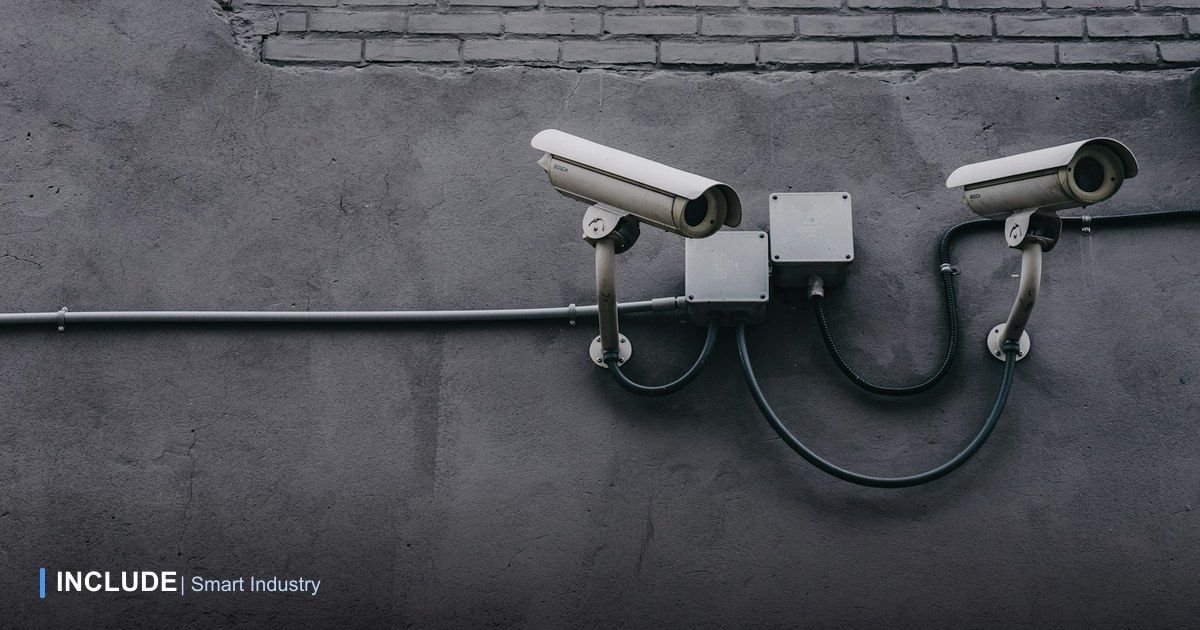
Most factories already have CCTV cameras installed, across production floors, warehouses, loading docks, and security posts. But their job usually stops at one thing: footage reviewed after an incident. For the other 23 hours and 55 minutes, dozens of cameras just record to storage that's rarely opened. Yet video is one of the richest operational data sources a plant already owns, it just has never been processed in real time.
Video analytics changes that. It doesn't replace the cameras; it adds an AI layer that reads the video live and turns it into structured events: a person detected without a helmet, a forklift entering a pedestrian zone, a longer-than-usual queue at the loading dock.
Why "just recording" isn't enough anymore
Three limitations of conventional CCTV that show up daily in operations:
- Reactive, not preventive. PPE violations or restricted-area breaches are only discovered when reviewing footage after an incident, not while they could still be prevented.
- No one truly watches 24 hours. A human guard can effectively focus on 4-6 screens for extended periods; attention fatigue is a physiological limit, not laziness.
- Visual data never becomes numbers. How many times did a forklift pass the same route? What's the average truck queue time at the dock? Answering that means manually re-watching hours of footage.
What video analytics actually does
Technically, a computer vision model runs on the camera feed (either on a local edge device or a server) and outputs structured events, not just video. The use cases with the most direct industrial impact:
- PPE detection. Helmets, vests, gloves: the system flags violations automatically in zones that require them.
- Danger zones & intrusion. Virtual lines around hazardous machinery or forklift paths trigger an alert when someone enters without authorization.
- Early smoke & fire detection. For high fire-risk areas, visual detection can be faster than conventional smoke sensors in open or ventilated spaces.
- Object counting & tracking. Vehicle counts, queue length, or people density in an area: data that previously needed a manual survey.
- Visual quality inspection. Catching visible product defects on high-speed lines, at a consistency human eyes can't sustain across a full shift.
What to check before choosing a platform
Not all "AI CCTV" is equal. Four questions worth asking any vendor:
- Do existing cameras need replacing? Many video analytics platforms accept RTSP/ONVIF feeds from already-installed cameras, your existing CCTV investment isn't wasted.
- What's the false alarm rate? An overly sensitive model sends hundreds of irrelevant alerts until the team stops paying attention, the same threshold-alarm problem seen with IoT sensors.
- Where do alerts go, and how fast? Detection without an escalation path (WhatsApp, dashboard, alarm system integration) just becomes a log nobody acts on.
- How is face/person data handled? For privacy compliance, ask whether the system performs individual facial identification or only detects general categories (e.g. "person without a helmet") without storing identity.
Common mistakes when starting video analytics
Three mistakes that most often stall a video analytics project after the initial demo:
- Enabling too many use cases at once. Trying to detect PPE, intrusion, density, and product quality simultaneously on day one overwhelms the team's ability to act on every alert. Start with one use case with the clearest impact, then add gradually.
- Not tuning sensitivity thresholds to local conditions. Lighting that shifts drastically from morning to night, or a non-ideal camera angle, means the model needs on-site recalibration, not just installation with default settings.
- No process owner on the ground. Just like IoT sensor alarm systems, video analytics alerts need someone responsible for following up, not just a log piling up on a dashboard with no clear owner.
How IncludeVision answers this
IncludeVision (the AI Vision platform in the INCLUDE Smart Industry ecosystem) turns already-installed CCTV into a real-time insight source, without requiring a camera swap. Detected events (PPE violations, zone intrusions, area density) can be forwarded as alerts to field teams, consistent with the same rule-based automation approach INCLUDE uses for sensor data. For plants that want to start with one high-risk area rather than the whole facility at once, that's a realistic starting point: pick one zone, one use case, measure the impact, then expand.
Curious which area of your plant would benefit most from video analytics?
Tell us how many cameras you already have and where. The INCLUDE team will help identify the most relevant use case to start with.
Free consultation on WhatsApp → See INCLUDE services →