

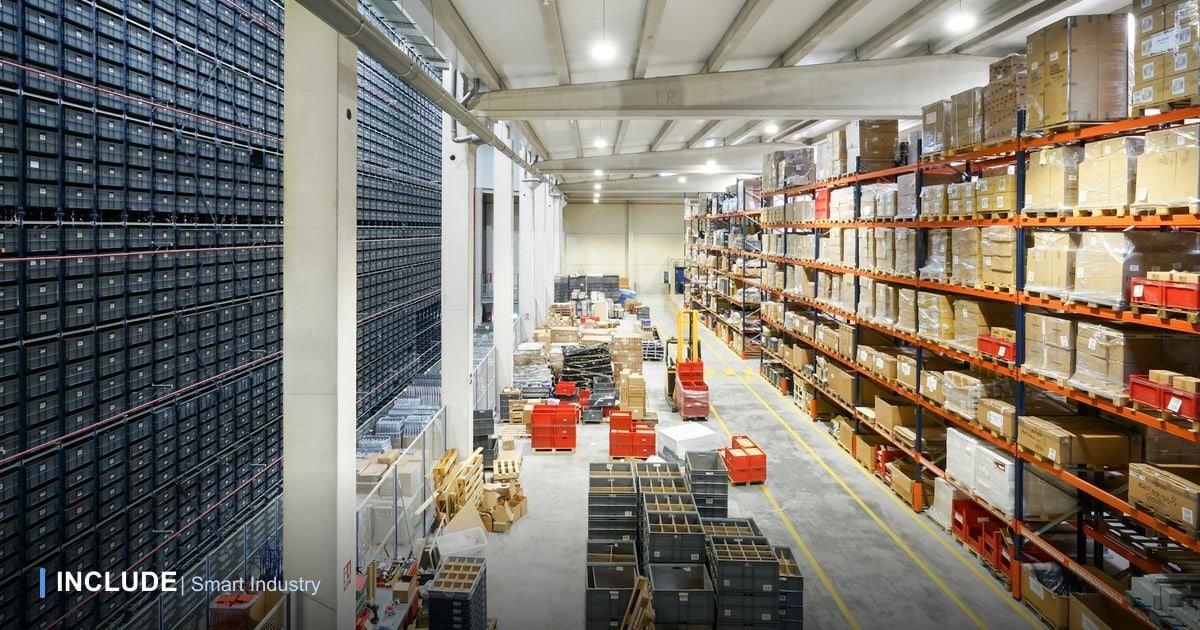
Raw material and finished goods warehouses are rarely seen as something to monitor. There is no refrigeration plant to fail, so conditions simply follow the weather. The damage shows up later: powders cake, cartons soften and stacks lean, labels peel, metal parts rust, or mould spots appear on pallets. Often the customer is the first to notice.
Warehouse temperature and humidity monitoring records air conditions continuously and alerts the team before goods are damaged. This guide covers ordinary ambient warehouses: why humidity matters as much as temperature, where sensors go, how to set alarms, and the records an audit asks for. For refrigerated rooms, see cold storage temperature monitoring.
Why humidity matters as much as temperature
- Hygroscopic materials absorb water. Sugar, flour, fertiliser, cement, and many powdered chemicals can cake. Some plastic resins also absorb moisture and need longer drying before processing.
- Cartons lose strength. Damp corrugated board crushes more easily, so tall stacks can lean or collapse. Labels and adhesives come loose too.
- Mould grows on wooden pallets, cartons, and organic materials when humidity stays high for long periods.
- Some electronic components are moisture sensitive and need dry storage.
- Temperature still counts. Under a metal roof, the air near the top of a warehouse gets much hotter during the day. Adhesives, paints, chemicals, cosmetics, and medicines often carry a storage limit on the label or data sheet, such as "store below 30 °C".
Dew point: the overlooked cause of rust
Relative humidity (RH) alone is not enough. What decides condensation is the dew point, the temperature at which water vapour in the air starts to condense. As an illustration, air at 30 °C and 80% RH has a dew point of about 26 °C. Steel coils or parts with a surface colder than that, for example fresh off an air-conditioned truck or still cool from the night, will sweat. That moisture is what starts rust.
For metal goods, track the dew point calculated from temperature and RH and compare it with the temperature of the goods. Dew point also guides ventilation: open up when the outside dew point is lower than the inside one, not just when outside air feels cooler.
Set limits per zone
Safe limits come from each product's storage specification: the label, the safety data sheet (SDS), supplier specifications, or customer requirements. One number for the whole building is rarely right. General examples:
| Goods | Risk | What to watch |
|---|---|---|
| Powders and hygroscopic materials | Caking, lower quality | Humidity |
| Finished goods in cartons | Soft packaging, collapsing stacks, mould | Humidity |
| Metal, coils, spare parts | Rust from condensation | Dew point and temperature swings |
| Chemicals, adhesives, cosmetics, medicines | Damage above the labelled limit | Maximum temperature |
Sensor placement starts with mapping
Before installing permanent sensors, map temperature and humidity. Place temporary data loggers in a grid and at several rack heights (low, middle, high) for a few days that include hot afternoons, nights, and a weekend. The result shows the hottest and dampest spots. Repeat when the layout, roof, or ventilation changes, and ideally in both the dry and rainy seasons.
Permanent sensors go at the worst spots, plus one point that represents each zone. A few practical rules:
- Place sensors on the top racks near the roof if goods are stored there, since hot air collects up high.
- Place sensors near the loading doors and walls that take the afternoon sun.
- Keep sensors out of the direct airflow of air conditioning, fans, exhausts, lights, and forklift chargers.
- Mount them clear of outside walls and steel columns, not flat against them.
- Put one sensor outside as a reference for ventilation decisions.
- Calibrate regularly. Humidity sensors drift over time. Check them against a reference instrument and keep the certificates for audits.
Alarms people act on
Threshold principles are covered in full in setting sensor alarm thresholds. For warehouses, what matters most:
- Two levels per zone: a warning near the limit, critical once it is crossed.
- A time delay, for example 15 to 30 minutes as a starting point, so doors open during loading do not trigger alarms.
- A silent-sensor alarm. A sensor that stops reporting is a problem, not a safe state.
- A written action for every alarm: close the doors, start the exhaust or dehumidifier, move sensitive goods, or check for roof leaks.
Records for audits
Customer audits and certifications usually ask for continuous records at a fixed interval, minimum and maximum values per period, every excursion with its duration and corrective action, sensor calibration evidence, and who is allowed to change limits. Paper logs struggle with all of that; see digitising production logsheets.
Requirements differ by sector. Pharmaceutical warehouses in Indonesia, for example, follow BPOM's Good Distribution Practice standard (CDOB), now set out in BPOM Regulation No. 20 of 2025. For food, cosmetics, or export customers, confirm the rules that apply to your products.
Things to keep in mind
- Sensors measure air, not the goods. A large pallet changes temperature far more slowly than the air around it.
- Wireless signals are often weak between dense steel racks. Test coverage before fixing sensor positions.
- Data retention on the platform depends on the subscription plan. Export and archive records in line with your company's document retention period.
- Monitoring does not fix the building. Roof insulation, ventilation, and leaks still need attention.
Frequently asked questions
How many sensors do we need?
It depends on floor area, rack height, and the number of zones; the mapping results decide. A sensible start is the worst spots, one representative point per zone, and one sensor outside.
How is this different from an ordinary data logger?
A standalone logger keeps data that is only seen when someone downloads it, so excursions are found late. Online monitoring sends data continuously and raises alarms immediately. Loggers are still useful for mapping.
Does the whole warehouse need air conditioning or dehumidifiers?
Not necessarily. Data often shows the problem is concentrated in certain zones or hours, so controlled ventilation, a small conditioned room, or moving sensitive goods may be enough.
Warehouse temperature and humidity monitoring with INCLUDE
On the INCLUDE platform, temperature and humidity sensors can send data over MQTT or the HTTP Device API, while sensors and transmitters with a Modbus RTU output connect through IncludeGateways. Each device gets a safe range per parameter. Readings outside it become alarms in Notifications and can be forwarded by email (Starter plan and above) or Telegram (Pro plan and above). History shows as charts that can be grouped by zone on a dashboard, can be exported to Excel, and every change made by users is kept in an audit trail.
From the IncludeBox line, the Weather Station measures outdoor air temperature and humidity as a reference for ventilation decisions, and the Energy Meter can track the power used by exhausts, air conditioning, or dehumidifiers. For points inside the warehouse, existing sensors can be used, or dedicated devices built through our IoT hardware development service.
Goods in your warehouse keep getting damaged by damp or heat?
Tell us about the floor area, the goods you store, and any sensors already installed. The INCLUDE team will help choose measuring points, alarm limits, and how to connect them.
Free consultation on WhatsApp → See the INCLUDE platform →