

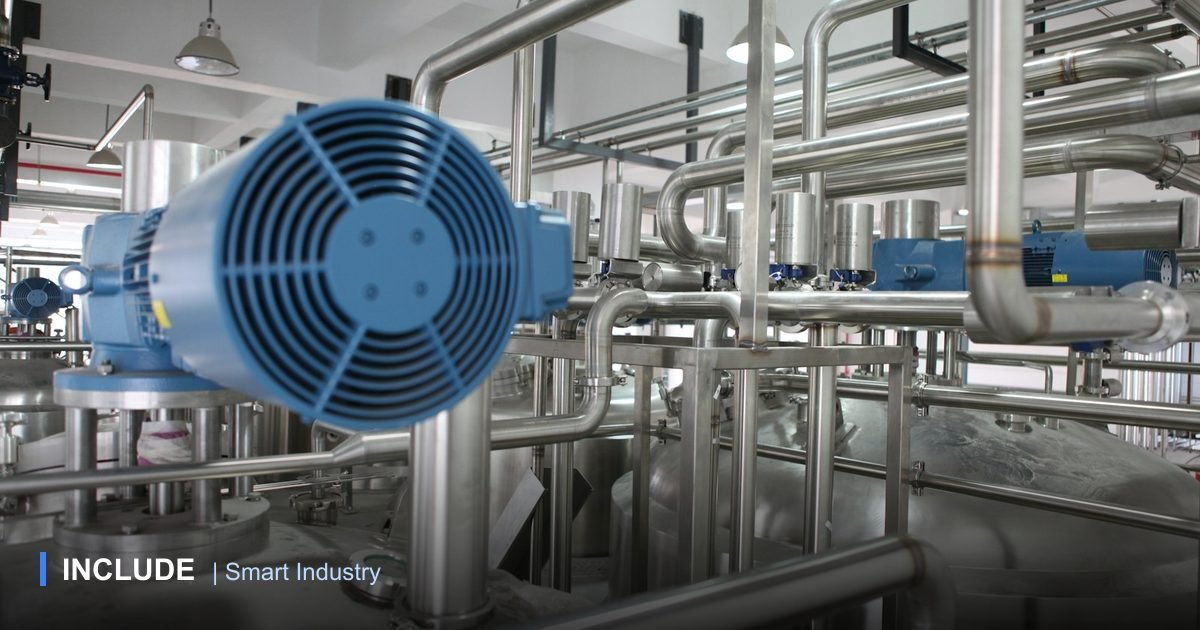
Rotating machines (pumps, induction motors, compressors, blowers) rarely fail in an instant. There is almost always a symptom that shows up first: vibration slowly rising, a bearing starting to run hot, or a sound that changes slightly. The problem is that these symptoms only get noticed if someone happens to walk by and touch the machine, and that coincidence cannot be a maintenance strategy.
Why rotating-machine failure feels "sudden"
For a production team, a bearing or motor failure often feels like it came without warning. Physically, though, mechanical degradation is almost always gradual:
- Vibration rises before temperature does. Imbalance, misalignment, or an aging bearing raise vibration levels long before heat becomes noticeable on the casing surface.
- A bearing temperature rise is often only noticed once it's advanced. A human hand can only distinguish "warm" from "normal" over a fairly wide range, by that point the damage has often already progressed.
- Manual rounds are inconsistent. A walk-around check done once per shift or per day misses changes that happen between two rounds, and the most critical machine isn't necessarily the one that gets checked most often.
The consequence isn't just a more expensive emergency repair, but also unscheduled downtime that disrupts the production schedule, something far cheaper to prevent than to handle after the fact.
Why sensor installation keeps getting postponed
Many plants already understand the value of condition monitoring, yet keep delaying it for three recurring reasons:
- Fear of having to shut the line down for installation. Running new cable to every measurement point means stopping production, hard to schedule on a plant that runs nearly 24 hours.
- A new control panel feels expensive upfront. Conventional monitoring systems are often sold as a full instrumentation project, not an incremental add-on.
- Uncertainty over which machine to monitor first. Without baseline data, prioritization is hard, and that hesitation alone postpones the decision for years.
How IncludeBox monitors without new wiring
IncludeBox is a plug-and-play wireless IoT sensor in INCLUDE's ecosystem, designed specifically to remove the three obstacles above:
- Installed without stopping the machine. The sensor attaches to the casing or bearing housing using a magnetic mount or industrial adhesive, no drilling, no disassembly, and no need for the machine to stop during installation.
- Measures several parameters at once. Vibration (RMS velocity), surface temperature, and on some variants electrical current: three signals that together give a far more complete picture of machine condition than any single parameter alone.
- Sends data over existing infrastructure. Data from IncludeBox is relayed to the platform via IncludeGateways over the plant network, 4G, or LoRa: well suited to measurement points far from the panel room.
- Added incrementally. Because each unit stands alone wirelessly, adding a new measurement point doesn't require reworking the system already running.
Building a baseline before setting alarm thresholds
A step teams new to condition monitoring often skip is building a baseline: the normal vibration and temperature range for each machine under its own load conditions. Without a baseline, alarm thresholds are just guesses; with one, thresholds become machine-specific:
- Record a few weeks of normal operation to see the reasonable vibration and temperature range at each load condition.
- Set tiered thresholds: an early warning as it approaches the top of the normal range, a firm alarm once it truly exceeds it.
- Tailor thresholds per machine type. Pumps, motors, and compressors have different normal vibration signatures; a generic threshold across all machines often produces irrelevant alarms.
A good baseline makes notifications credible, once the team receives an alarm, they know it's a genuine deviation, not normal variation that gets dismissed every time.
From vibration data to maintenance decisions
Once data is flowing and a baseline is established, the most common decisions that follow:
- Scheduling repair before breakdown. A bearing whose vibration is climbing gradually can have its replacement scheduled during planned downtime, not an emergency stop.
- Prioritizing critical machines. Limited maintenance budget can be directed at machines whose data shows a worsening trend, instead of a uniform preventive schedule for every machine.
- Verifying repair results. After a bearing replacement or realignment, vibration data shows whether the repair actually brought levels back into the normal range.
- Becoming the foundation for further analytics. Well-organized historical vibration and temperature data is the raw material for machine-learning-based anomaly detection, once that need matures.
Start with the machine that's most costly if it stops suddenly
Not every rotating machine needs monitoring at once. The most efficient starting point: the machine whose downtime disrupts production the most, typically a line's main motor, a high-pressure air compressor, or a critical process pump. Once the data pattern proves useful, expanding to other machines becomes far easier to justify.
For more complex needs (connecting vibration data to a machine-learning failure-prediction model) the INCLUDE services team can build on top of the same data.
Frequently asked questions
Where should a vibration sensor be mounted?
As close to the bearing as possible, on a rigid surface, where early signs of failure read most clearly.
Have a rotating machine that has never had its condition monitored?
Tell us about the machine and its past failure patterns. The INCLUDE team will help identify the highest-impact sensor placement.
Free consultation on WhatsApp → See IncludeBox →