

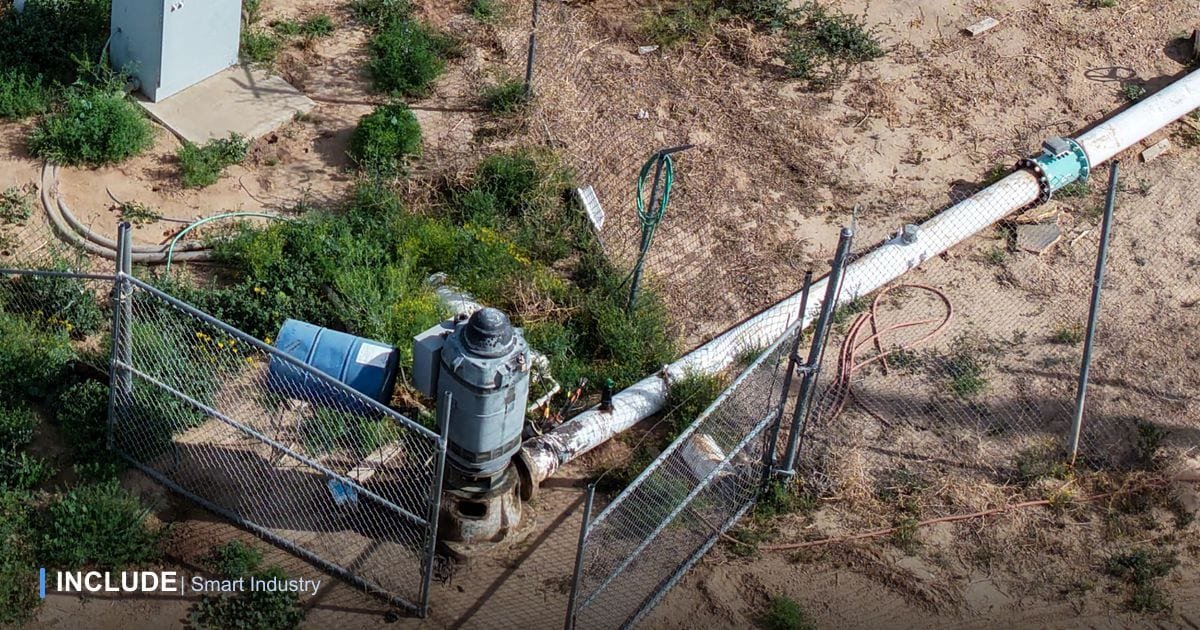
Many factories, hotels, hospitals, and industrial estates rely on deep wells, and record-keeping is often still manual: someone reads the meter once a month and copies the figure into a report. Missed readings get estimated, and a leaking pipe or a pump running all night goes unnoticed until the next reading.
Groundwater abstraction monitoring replaces that monthly reading with data that records itself every few minutes. This guide covers what to measure at a well, how to choose a flow meter, how to get it online, periodic reporting, and alarms that catch leaks and overuse.
Why monitor groundwater abstraction
- Permits and reporting. Taking groundwater for business use in Indonesia requires a government permit or approval, and holders are generally required to fit a water meter and report abstraction volumes periodically. The details, including volume limits, format, and reporting frequency, are set out in your permit and local regulations.
- Groundwater tax. A regional tax governed by Law No. 1 of 2022 and local regulations; abstracted volume is one factor in the calculation, so accurate readings feed straight into cost.
- Pumping electricity. Every leaked cubic metre has still been lifted from depth, and that power paid for.
- Well health. Lower flow from the same pumping hours can point to a worn pump, a clogged well screen, or a falling water table.
What to measure at a well
| Parameter | Unit | What it is for |
|---|---|---|
| Flow rate | m³/h or litres per second | Confirming the pump runs normally, spotting surges and night flow |
| Cumulative volume (totaliser) | m³ | The basis for usage reports and tax |
| Pump status and running hours | hours | Linking usage to the pump schedule |
| Pump energy | kWh | kWh per m³, a sign of a declining pump or well |
| Discharge pressure | bar | Telling leaks apart from changes in demand |
| Well water level (optional) | metres | Tracking drawdown during and after pumping |
Flow rate shows what is happening now; the totaliser shows how much has been taken. For reports, use the meter's own totaliser rather than summing flow readings, since flow data lost during a connection drop leaves the total short.
Choosing a well flow meter that can be read online
- Mechanical meters with a pulse output. Cheap and common; the pulse output lets them be read automatically. Moving parts wear if the water carries sand.
- Electromagnetic meters. No moving parts, accurate across a wide flow range, and many offer Modbus RTU or 4-20 mA outputs. The liquid must be conductive, which groundwater generally is.
- Ultrasonic meters. Some clamp onto the outside of the pipe, useful when the pipe cannot be cut. Accuracy depends heavily on installation.
Whatever the type, respect the straight pipe lengths upstream and downstream that the manufacturer specifies, size the meter for the flow range (not just the pipe diameter), and make sure the pipe runs full at the meter.
If the installed meter is sealed or inspected by the authorities, do not modify it. Ask whether a pulse transmitter may be added, or fit a second meter for internal monitoring.
From meter to online data
- Read the meter output. A Modbus RTU meter is read directly over an RS-485 cable. Pulse or 4-20 mA outputs first go to a counter or analogue input module with a Modbus output.
- Send it through a gateway. A gateway in the pump panel reads the meter and forwards data to the platform; wells beyond the office network can use 4G. The options are compared in our guide to choosing IoT connectivity.
- Set the interval. Data every 1 to 15 minutes is enough to see daily patterns and night flow. Store flow rate and totaliser together.
- Check against manual readings for the first few days, to prove the pulse scaling or Modbus registers are right.
Usage records and periodic reports
Once data flows in, daily, weekly, and monthly use per well is available without a trip to the pump house. A typical report includes:
- Opening and closing totaliser readings per well, and the difference.
- Daily use, so unusual days stand out.
- A comparison with the volume limit in the permit.
- A log of problems: meter faults, missing data, or pump replacements.
As an illustration, suppose a well's permit allows 3,000 m³ a month. If use has reached 1,800 m³ by the 15th, that rate points to about 3,600 m³ by month end. A mid-month warning leaves time to manage demand; a manual reading at month end only tells you the limit has already been passed.
Alarms for leaks and overuse
- Flow when there should be none. If production stops at night or over the weekend but flow does not drop, suspect a leak, an overflowing tank, or an open tap. The method is covered in our article on leak detection with Minimum Night Flow.
- A sudden surge in flow, a sign of a burst pipe or a valve left wide open.
- Daily use above plan, or a monthly projection that exceeds the permit limit.
- Pump running but flow low. If pump energy holds steady while flow falls, check the pump, the screen, or the well level.
- Destination tank overflowing. Monitoring the tank level stops waste at the end of the line. See our guide to tank water level sensors.
- Data stops arriving, so a dead meter or connection is never mistaken for an idle well.
As another illustration, a 2 m³/h leak over 8 night hours comes to 16 m³ a day, or about 480 m³ a month: water that is pumped, paid for in electricity, and recorded on the meter without ever being used.
Things to keep in mind
- Online data does not automatically replace official reports. Follow the format and channel the authorities require; automatic data just makes reports faster and easier to defend.
- Meter accuracy drifts over time, especially mechanical meters on sandy water. Check or calibrate as the manufacturer recommends.
- Wells are often remote. Plan power supply, protection from lightning and water, and cellular coverage before installing equipment.
- Rules differ by region. Confirm the obligations for your wells with the relevant local office before preparing reports.
Frequently asked questions
Must a factory deep well have a water meter?
Generally yes for permit or approval holders. The exact requirements are in your permit and local regulations.
Can an old mechanical meter be brought online?
Yes, if it has a pulse output or can take a pulse transmitter. If not, add a meter with a digital output, minding the point on sealed meters above.
Do we need office internet at the well?
No. A gateway with a 4G modem can send data wherever the pump house has cellular signal.
What data interval works best?
For reports and daily patterns, 5 to 15 minutes is enough. To catch short surges, a 1-minute interval helps more.
Groundwater abstraction monitoring with InWater
InWater treats each flow meter as a zone, so every well gets flow rate, minimum night flow, peak flow, pressure where measured, and 7-day supplied volume, with supply compared across zones. If night flow never drops, InWater flags a suspected leak; for wells that pump around the clock, read that flag against the production schedule. Tank levels and water quality share the dashboard, and any parameter can have a safe range that raises alarms, forwarded to Telegram if needed.
Flow meters with a Modbus RTU output are read through IncludeGateways over RS-485, then sent over 4G from pump houses beyond the office network. Data can be exported for reporting, and the Business plan adds scheduled reports. InWater is available from the Starter plan.
Still reading your well meters by hand?
Tell us how many wells you have, the water meters installed, and the signal at the pump house. The INCLUDE team will help set up automatic flow records.
Free consultation on WhatsApp → See InWater →