

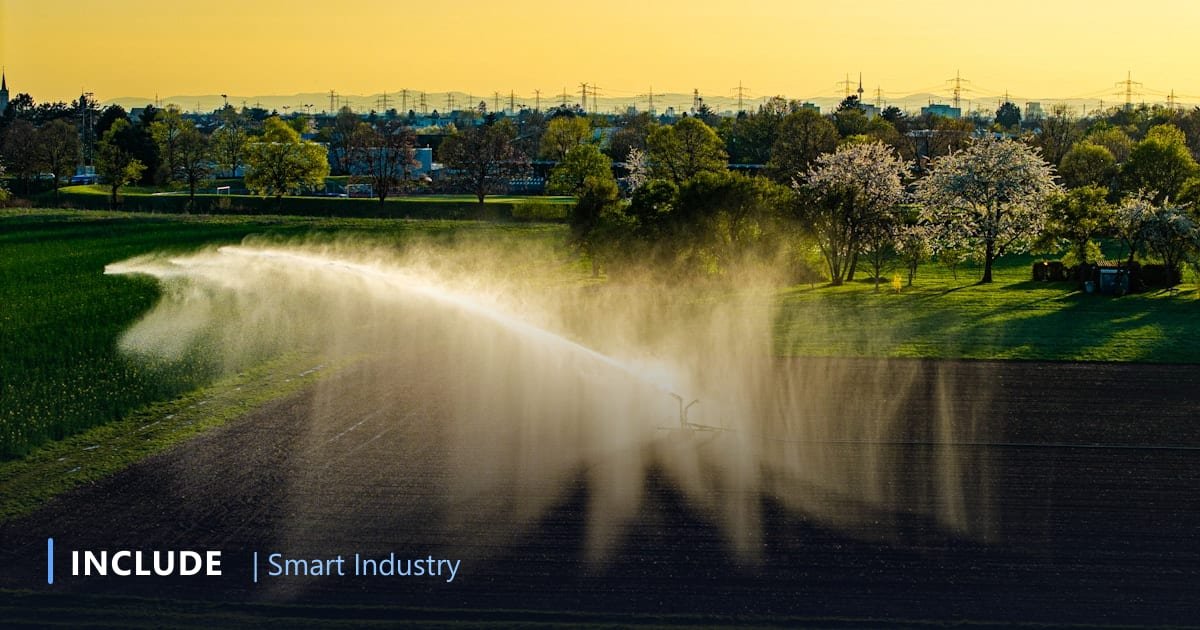
Most orchards and horticultural sites still irrigate by the clock rather than by plant need: seven in the morning and four in the afternoon, every day, all season. A fixed schedule carries two costs that are rarely counted. Watering while the soil is still wet wastes water and pump electricity, and pushes dissolved fertiliser down past the root zone. Watering too late, once the crop is already under water stress, reduces yield with no immediately visible symptom.
Both come from the same cause: nobody knows the state of the soil at the moment the water is applied.
Four numbers that change the watering decision
Replacing a fixed schedule does not require dozens of sensors. Four parameters are enough to change daily decisions:
- Soil moisture in the root zone — the primary signal. Installation depth determines whether it is relevant at all; a surface sensor measures evaporation, not water actually available to roots.
- Soil temperature — affects water uptake rate and root activity, particularly in the morning.
- Rainfall — 10 mm overnight removes the need for a morning cycle entirely. Without this data, the pump runs anyway.
- Solar radiation and wind speed — together these govern how fast water leaves the crop and the soil. A clear, windy day demands far more water than an overcast day at the same temperature.
From readings to a schedule
Data alone changes nothing. What changes things is a small set of rules the field team agrees on. The usual shape:
- Lower threshold — irrigation triggers when root-zone moisture falls below a set value, not when the clock reads seven.
- Rain delay — if rainfall over the past 24 hours exceeds a threshold, the next cycle is skipped automatically.
- Upper limit — irrigation stops once moisture reaches field capacity, so water does not keep draining past the root zone.
- Time window — cycles remain confined to certain hours to avoid midday evaporation and the disease risk of foliage staying wet overnight.
Note that the schedule is not abolished; the schedule becomes the boundary, while the data decides whether a cycle actually runs.
What usually goes wrong at installation
Decision quality cannot exceed sensor placement quality. Four recurring mistakes:
- Too shallow. A sensor 5 cm down tracks evaporation, not water available to roots. Install at the active root-zone depth for the crop actually planted.
- One point for the whole site. Blocks with different soil texture, slope, or shade behave differently. One sensor per irrigation zone is far more useful than five clustered in one block.
- Placed somewhere unrepresentative. Beside a channel, in a hollow, or directly under an emitter gives a misleading figure for the entire block.
- Never re-checked. Sensors shift during cultivation and readings drift quietly. Periodic verification is far cheaper than a season of wrong decisions.
Benefits beyond saving water
Water savings get mentioned first, but the other effects are often worth more:
- Pump electricity. Every unnecessary cycle is pump running time paid for in full.
- Fertiliser efficiency. Excess water carries nutrients below the root zone. Cutting over-irrigation means the same fertiliser works longer.
- Earlier fault detection. Moisture that fails to rise after a cycle means something is wrong — a blocked emitter, a leaking line, a failed valve. Without sensors this only surfaces once the crop shows symptoms.
- A traceable record. Soil and weather history per block makes season-to-season comparison possible rather than a matter of memory.
Start with one zone, not the whole property
Instrumenting every block at once creates a large upfront cost before a single benefit has been demonstrated. The safer order:
- Pick the single most troublesome irrigation zone — usually the block with the least consistent yield, or the one most often suspected of over-watering.
- Run two to four weeks without changing anything. The point is to learn that block's normal behaviour: how fast the soil dries after a cycle, and how long rainfall keeps having an effect.
- Only then change the watering rules, based on the pattern you can see rather than on initial assumptions.
- Compare against the neighbouring block still running the old schedule. A side-by-side comparison within one season persuades management far more effectively than a theoretical savings figure.
Once one zone is proven, expanding to the rest moves quickly because sensor placement and moisture thresholds have already been tested in your own soil.
How InFarmer does it
InFarmer is the precision agriculture solution within IncludeApps. A 7-in-1 soil sensor reads moisture, pH, EC, temperature, and N-P-K, while a weather station logs rainfall, wind speed, solar radiation, and UV index. Everything lands in one dashboard, and early alarms fire when parameters leave the optimal range — including when moisture fails to rise despite a completed irrigation cycle.
For land spread far from any network, IncludeGateways collects field sensor nodes and forwards them to the platform over a single outbound path. How the device, connectivity, and platform layers relate is explained in our guide to IoT & AIoT platforms in Indonesia.
Still watering by the clock rather than by need?
Tell us your crop and the area involved — the INCLUDE team will suggest a sensible sensor count and placement to start with.
Konsultasi Gratis via WhatsApp → See InFarmer →